
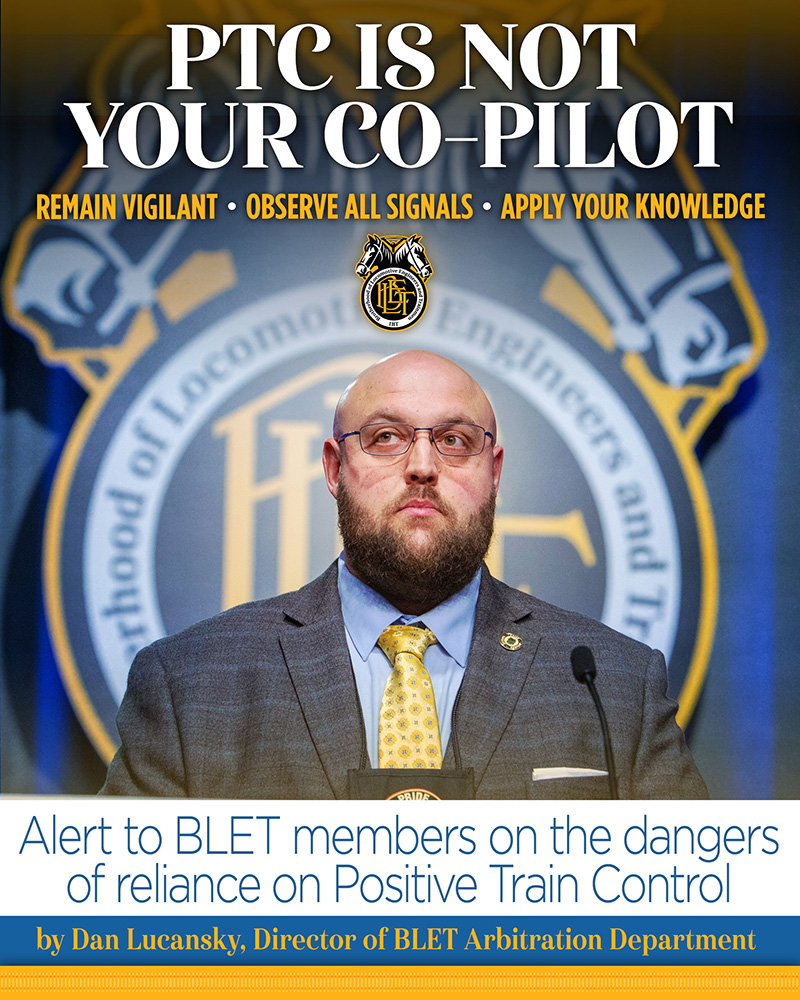
PTC Is Not Your Co-Pilot
By Dan Lucansky
Director of BLET Arbitration Department
(BLET Editor’s Note: The following was written by BLET Arbitration Department Director Dan Lucansky. The alert seeks to advise BLET locomotive engineers on discipline cases that have been advanced through the grievance process from various BLET General Committees of Adjustment across the country. This is the first in a regular series of articles that will highlight common case topics of interest to BLET members at the 1st Division and the Operating Craft Review Board.)
Positive Train Control and Energy Management Systems have fundamentally changed the way we operate as locomotive engineers. While it has been one of the most significant safety enhancements in railroad history, PTC is only a backstop and is not a substitute for proper training, human judgement, or a railroader’s expertise.
The BLET Arbitration Department would like to draw locomotive engineers’ attention to a growing concern across the industry; recent cases seem to point to a tendency for some engineers to allow PTC and EMS to do their thinking for them. PTC has been effective at preventing collisions, overspeed events, work zone and red signal violations, however, the most effective safety feature on a moving train continues to be YOU — the certified locomotive engineer.
PTC cannot detect obstructions or defects in the tracks: A vehicle, pedestrian, downed tree, debris from another train, broken rail, washout, the list goes on. A vigilant train crew remains the only way to detect these hazards and have time to act. PTC is not flawless, technology breaks down, the system can experience communication failures, GPS signal loss, software faults, and hardware malfunctions.
There is a documented phenomenon in which operators of automated systems gradually reduce their own monitoring and situational awareness because they trust the system to catch problems, what is termed automation complacency. It is a predictable and well-documented human response to working alongside reliable automation. The aviation industry has spent decades studying and combating this problem in airline pilots, and the rail industry must take it equally as serious.
Another risk found by researchers is mode confusion, when an engineer believes PTC is actively protecting the train when it is not. This may occur in several situations such as transitioning between PTC and non-PTC territory, when the system enters a degraded state, or exiting the main onto a siding or into a yard.
PTC is a safety overlay on existing operations, not a replacement for them. The fundamental duties of a locomotive engineer remain the same as they were prior to PTC, which include:
- Remain vigilant: Keep your eyes on the track ahead. Scan for obstructions, trespassers, grade crossings, signals, and anything out of the ordinary. No screen can replace what you see through the windshield.
- Observe all signals: Identify and job brief with your crew about upcoming restrictions.
- Apply your knowledge: You know your territory better than PTC or EMS, act before the system puts you into a poor situation.
The airline industry adopted advanced cockpit automation decades before PTC and EMS arrived in the locomotive cab, along with valuable lessons. One of the most significant findings is that pilots who relied on autopilot and flight management systems experienced a measurable decline in manual flying skills. When those automated systems fail, pilots who have not maintained their proficiency can find themselves in life-threatening situations.
PTC is just a layer of safety, not the foundation. The foundation of railroad safety has always been, and will always be, a well-trained and professional locomotive engineer at the controls.
(A Union Pacific locomotive engineer, Brother Lucansky is a member of BLET Division 96 in Chicago).