
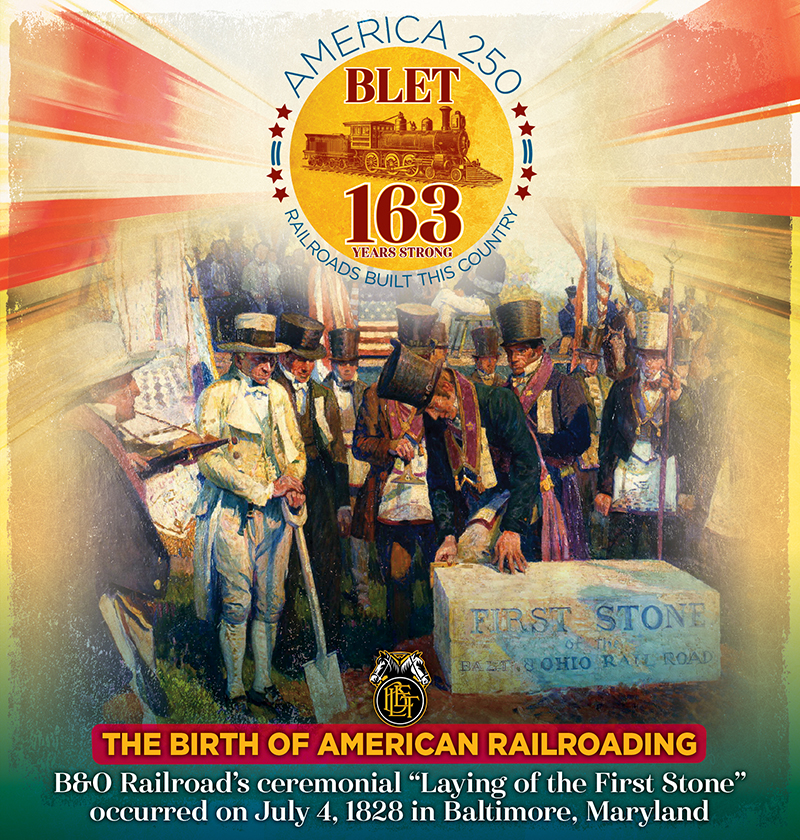
Editor’s Note: As America approaches its 250th birthday this year, the Brotherhood of Locomotive Engineers and Trainmen (BLET) is marking its 163rd anniversary. In recognition of these historic milestones, BLET, the oldest labor union in North America, is examining the importance of railroads and rail labor to our great nation. This is the first in a series of articles. This week, we take a look at the birth of railroading in the United States.
There may not have been any railroads in America in 1776, but without a doubt railroads played a critical role in the nation’s growth and development.
Widely recognized as the birth of American railroading, the Baltimore & Ohio (B&O) Railroad’s ceremonial “Laying of the First Stone” occurred on July 4, 1828. Among the dignitaries at the event was Charles Carroll of Carrollton, the last surviving signer of the Declaration of Independence. In his remarks that day, the 92 year old Founding Father prophesized about the importance of railroads to the young nation:
“I consider this among the most important acts of my life, second only to that of signing the Declaration of Independence, if even second to that,” said Carroll, according a report published in the September 1876 issue of the Locomotive Engineers Journal.
Carroll passed away before his prophetic vision came to fruition. After his death in 1832, railroad operations would gradually expand over the next three decades, connecting the country and allowing for the transport of people and goods with increased speeds at dramatically lowered costs.
Another major milestone in the history of American railroading and organized labor would happen 35 years later, on May 8, 1863, when a union for locomotive engineers was founded. More about that in our next report.
“Laying of the First Stone” image courtesy of CSX Transportation