
“Four score and seven years ago our fathers brought forth on this continent a new nation, conceived in liberty, and dedicated to the proposition that all men are created equal.”
So begins the famous Gettysburg Address by President Abraham Lincoln. He gave this speech on November 19, 1863, 87 years after the signing of the Declaration of Independence and just a few months after the founding of the Brotherhood of Locomotive Engineers and Trainmen (BLET).
The BLET came into existence four score and seven years after America was founded, making it the oldest labor union in North America.
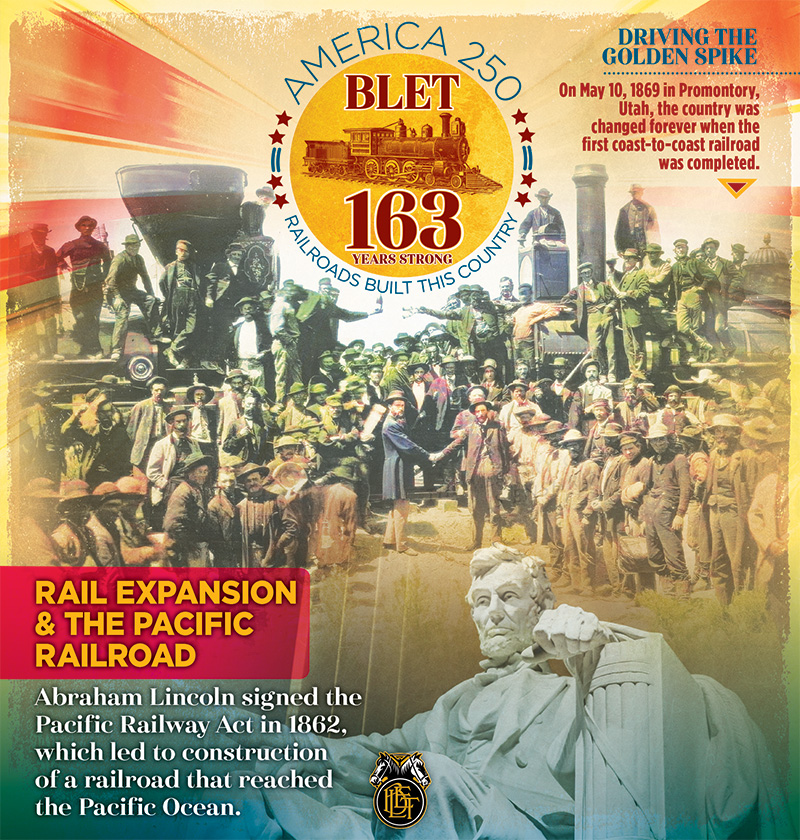
Lincoln is considered by many to be America’s greatest president. In addition to holding the nation together during the Civil War and ending slavery, one of his most significant acts came on July 1, 1862, when he signed the Pacific Railway Act, which provided federal land grants and government bonds to fund construction of a railroad that reached the Pacific Ocean. The driving of the golden spike at Promontory, Utah, on May 10, 1869, brought the country together and helped heal wounds from the Civil War. The Pacific Railroad conquered the mountains, prairies and deserts between the Mississippi River and the Pacific Ocean, opening the continent to settlement and speeding the transformation of the United States from an agricultural to an industrial nation.
Growth of the newly-formed Brotherhood reflected that of America’s expanding railroad system. The union was founded on May 8, 1863. The young organization grew rapidly. By 1864, 54 Divisions were organized. By 1875, 189 Divisions were established, representing more than 10,000 members. The early BLET fought to secure better working conditions and increased pay for members, and to uplift the character and social standing of the locomotive engineer
President Lincoln would be assassinated before completion of his railroad to the Pacific. Fittingly, members of the BLET operated Lincoln’s funeral train as it carried his remains from Washington, D.C. to his final resting place in Springfield, Ill. One of those locomotive engineers was Peter M. Arthur, a member of BLET Division 46 (Albany, N.Y.), who operated the funeral train over a segment of the New York Central in April of 1865. Nine years later, Arthur would be elected Grand Chief Engineer, now referred to as National President, of the Brotherhood.
An economic crisis and deadly labor struggles lay ahead for the industry and the Brotherhood. The BLET would use its power and influence to overcome the strife and help secure better working and living conditions for all Americans. More in our next installment.