
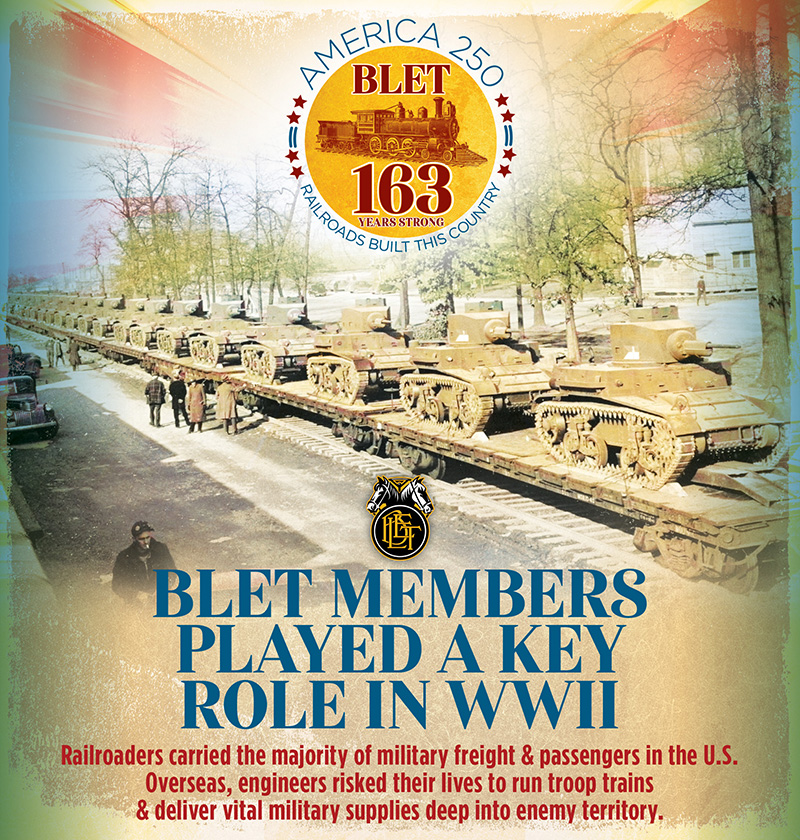
American railroads and railroad workers proved vital to the Allied victory during World War II, both at home and abroad. At home, U.S. railroads — with BLET members at the throttle — carried 90 percent of all military freight and 97 percent of all military passenger movements. Overseas, engineers risked their lives to safely transport troops and other vital military equipment deep into enemy territory.
“The North American continent produced, without a doubt, the deciding force of munitions, machines, and men that turned the tide of battle in Europe and crushed Hitler’s fanatical hordes,” according to an editorial in the June 1945 Locomotive Engineers Journal. “Behind the heroes of the front-lines are the heroes of the home front… Without detracting from the hallowed term ‘V-E Day’ and without stretching the imagination it is easy to regard it as representing also ‘V-ictory for E-ngineers.’ Such an application would be quite correct, for locomotive engineers have been doing a superhuman job of keeping war goods flowing to our armies in all parts of the world.”
Overseas, locomotive engineers risked life and limb to make their contributions to the campaign in Europe. “Locomotive engineers… are blazing a rugged trail over many, bloody battlefields as they operate troop and supply trains of all kinds over the intricate network of tracks running from the Western European seaports right into Nazi Germany,” according to the February 1945 Locomotive Engineers Journal.
An official U.S. Army account of rail operations, from the July 1945 Journal, provides harrowing details of what engineers faced in European operations. “Blackout nerves were universal among pilot-engineers throughout the continental campaign. Even in areas where trains might safely operate with headlights, due to a depleted Luftwaffe, the equipment was not available… A ride in the engineer’s cab on a black night was enough to convince anyone that the most experienced man could not be sure of what section of rail he was traversing, let alone spot any danger which might be lying ahead… There is something about a heavily loaded train creeping forward in pitch-blackness over sagging rails into unknown territory which brings cold sweat to the palms of one’s hands and tightens the nerves of the sturdiest of men.”
After V-J Day and the end of World War II, the September 1945 Journal reported: “In a quiet unobtrusive way the highly skilled locomotive engineer has made his important contribution towards freeing the world of aggression. Our nation can well be proud of its railroads and railroad employees during the long, tedious months of the war as they should be also in peacetime.”